AI agents are moving closer to the point where they can do more than research, recommend or prepare a transaction.
They can increasingly act.
That matters in financial services because there is a major difference between an AI agent suggesting that a payment should be made and an AI agent actually initiating that payment.
In September 2026, Federal Reserve Governor Christopher Waller addressed this directly in a speech about payments in the age of AI agents.
He pointed to business payments as a particularly relevant use case. Many business payments already follow clear rules around approved suppliers, budgets and payment methods. This makes them well suited for automation.
But there is another side to that opportunity.
Business transactions often involve larger amounts of money. If an agent makes a mistake or performs an unauthorized action, the financial exposure can be much higher.
This changes the control question.
It is no longer enough to ask whether the user behind the transaction is authorized.
Financial institutions also need to know whether the AI agent itself has the authority to perform that specific action.
NIST has raised a similar issue.
Its work on AI agent identity and authorization argues that agents should increasingly be treated as distinct digital entities, with their own identity, permissions and access rights.
This becomes especially important when agents interact with several systems.
An agent may have permission to access an account, but that does not automatically mean it should be allowed to initiate every payment from that account.
It may be allowed to pay one supplier but not another.
It may be allowed to execute payments below a certain amount but require approval above that amount.
It may be allowed to act during a specific workflow but not outside it.
This is where financial AI needs more than traditional authentication.
It needs control over execution.
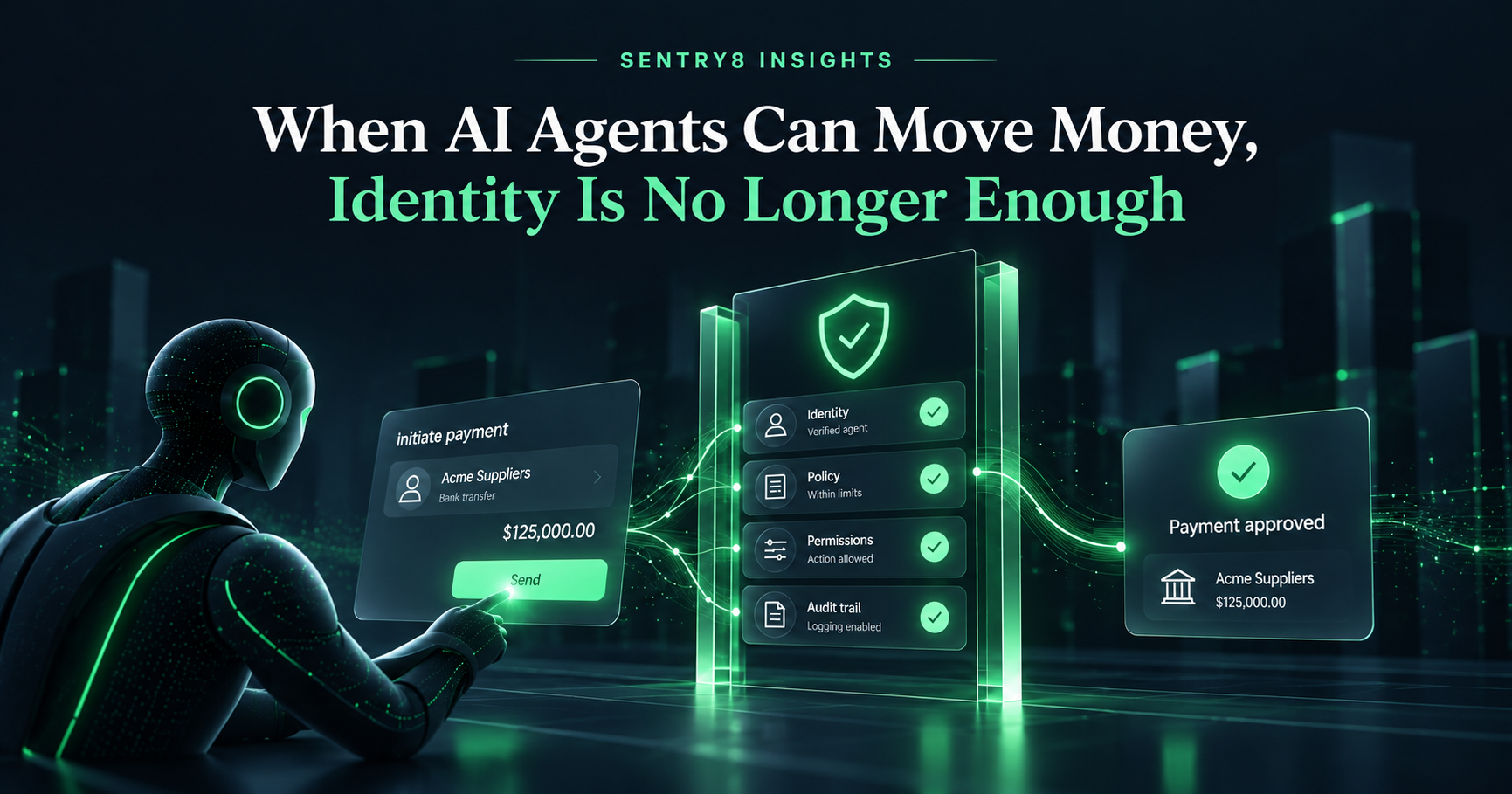
The system needs to understand who the agent is, what it is trying to do, what permissions apply, what policy governs the action and whether human approval is required.
That is the layer Sentry8 is designed to address.
Sentry8 sits between an AI agent's intent and the real action it wants to execute.
The goal is not to remove autonomy.
The goal is to make autonomy safe enough to use in environments where mistakes have financial, operational and regulatory consequences.
As AI agents gain access to real financial systems, the question will increasingly move from:
Can this agent connect?
to:
Should this specific action be allowed right now?
That distinction may become one of the most important control questions in the financial system.